Climate change is the greatest challenge facing the word today and it is caused by increased concentration of greenhouse gas in the atmosphere. Methane gas which has its sources from Fossil fuel extraction and production, livestock digestion (enteric fermentation), rice cultivation, landfills, and wastewater treatment is considered a powerful greenhouse gas with a higher global warming potential than carbon dioxide over a relatively short timescale. It is estimated to be over 25 times more effective at trapping heat in the atmosphere compared to CO2. Reducing methane emission is therefore critical if the fight against climate change is to be won.
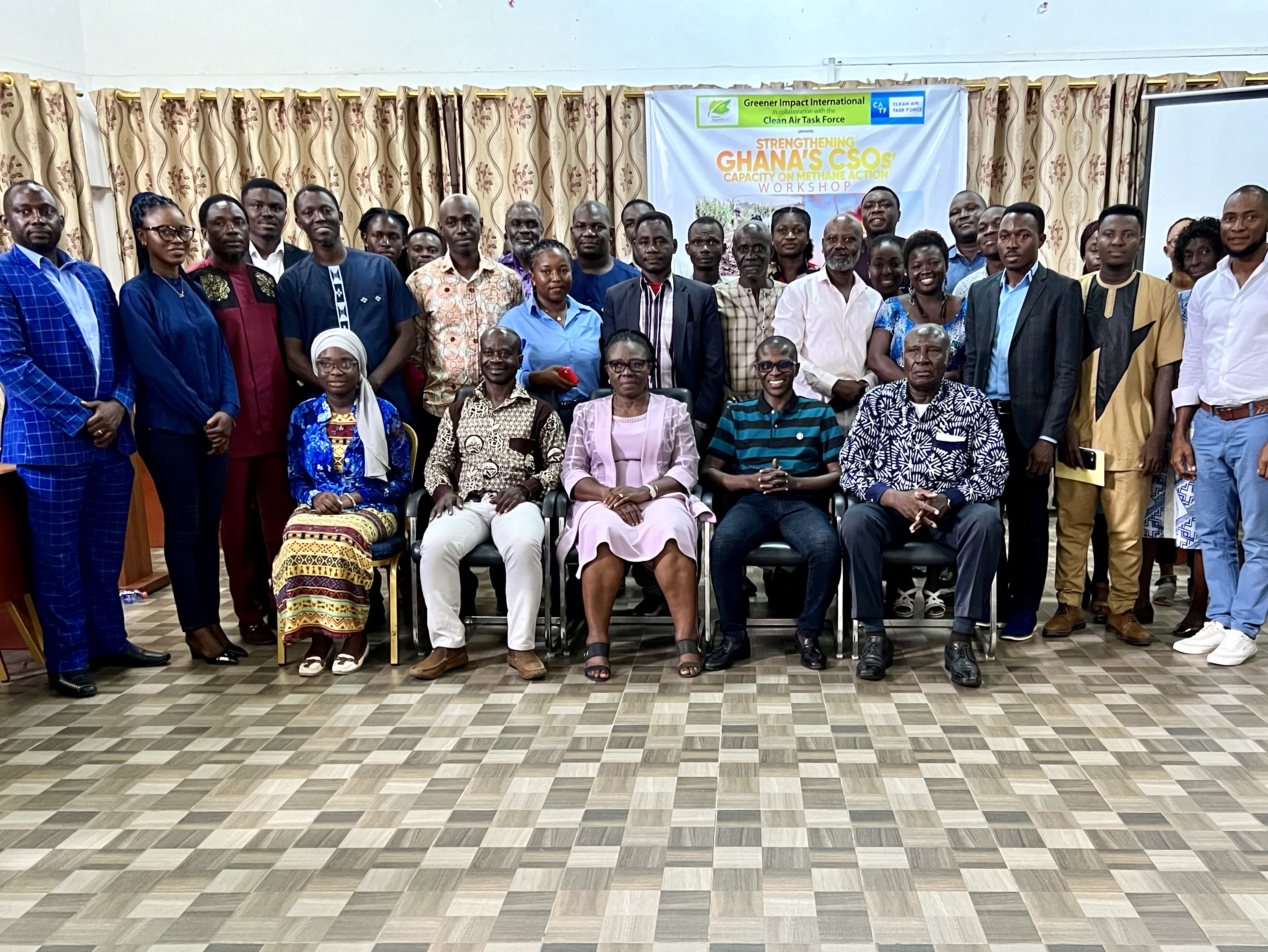
Greener Impact International (GII) ahead of the 28th session of the Conference of Parties (COP28) to the UNFCCC, hosted a one-day workshop to build the capacity of Ghana’s CSOs on sources of methane gas and to empower them to develop high impact projects that deliver mitigation outcomes and enhance community resilience. Held in a hybrid format, this workshop had representation of about forty organizations from the Civils Society space in Ghana mostly from the Greater Accra region.
The workshop consisted of a technical session with presentations from technical experts from relevant institutions. A presentation from Dr. Mutala Mohammed, a research scientist and head of sustainable energy technology division of the Council for Scientific and Industrial research (CSIR) provided insight on global methane emission and its impact on the climate system. He describes methane gas as an air pollutant with detrimental effect on human and ecosystems. He explained that Methane gas has significant contribution to the global climate crisis as it accounts for 30% of historical greenhouse emission. He further outlined the global action to monitor and address methane using technologies including use of satellites.
Dr. Antwi Bosiako-Amoah, acting director of climate vulnerabilities and adaptation from the Ghana’s Environmental Protection Agency (EPA) provided insight about Ghana’s actions against methane emission. Recalling to the attention of the audience that Ghana is among the countries that have signed on to the global methane pledge which sets a target for countries to reduce their methane emissions by at least 30% below 2020 level by 2030, Dr. Bosiako Amoah outlined some of the policy actions taken by the government of Ghana towards achieving this goal. He also mentioned about Ghana’s plan to include specific targets for methane mitigation in the next round of submission of the Nationally Determined Contributions (NDCs).
He further shared that only 2% of global climate finance goes into methane mitigation and that achieving the global methane pledge will require increased provision in climate finance and deployment of appropriate technologies to developing countries.
He encouraged CSOs to tap into the opportunities by increasing community awareness and promoting the adoption of clean energy technologies.
His presentation was followed by that of Mr. Timothy Apeanti, the lead researcher from GII on the case study on Methane. He presented to the audience a summary report with key findings from the case study. Then, was set a panel of technical experts who shared their experiences by presenting actionable solutions, opportunities, barriers and challenges on the topic. The panel members included Dr. Samuel Dotse from the HATOF Foundation, Mr. Lovans Owusu Takyie from the Institute for Sustainable Energy and Environmental Solution (ISEES) and Dr. John Afari Idan from the Biogas Technologies West Africa.
In a closing remarks from Mr. Kassim Gawusu-Toure, the Executive Director of Greener Impact International thanked both the in-person and online participants, the resource persons and the media for the interest showed in the presentations and their contributions to the discussions. He also thanked the Clean Air Task Force for their support highlighting GII’s interest to follow up on more awareness creation on methane and to explore opportunities for implementation of concrete projects for methane abatement